Tuesday, June 19, 2012

G20 summit meeting in Mexico

US News

G20 summit meeting in Mexico

Reuters | June 19, 2012 | 12:36 PM EDT

LOS CABOS, Mexico (Reuters) - The following are highlights of comments by leaders and officials at the Group of 20 summit meeting in the Mexican beach resort of Los Cabos on Tuesday.

GERMAN CHANCELLOR ANGELA MERKEL "We had a very intensive discussion about the different risks for a sustainable growth."

"There are various fields which cause concern, which include the issue of budget-consolidation in the U.S. and the economic policy in some emerging-countries."

On pressure on Europeans: "It is obvious that we have problems in the euro zone, and that it is necessary to act ... but the important thing is ... that we (the Europeans) have made clear that we are determined to act."

On Greece: "I have talked to (IMF chief Christine) Lagarde yesterday. I asked her to get the next troika-delegation pretty fast to Greece."

"Before acting we now at first have to wait for the results of the troika-mission. The rules have to be followed."

tony blankley steelers charles barkley beyonce troy polamalu james harrison james harrison

Children's Health & Fitness ? Soda Not The Main Culprit To ...

June 18th, 2012 by Len Saunders

From The New York Daily News?..

As New Yorkers continue to debate a controversial proposal to ban supersized sodas, a new study out of Canada says the link between the consumption of sweetened beverages and childhood obesity is weak at best.

It?s the latest study to weigh in on the controversy which has divided the city, with supporters lauding Mayor Michael Bloomberg?s initiative to combat rising obesity and others calling the strategy shortsighted.

The Canadian study, to be published in the October issue of Applied Physiology, Nutrition, and Metabolism, determined that more than the consumption of sugary drinks, the main predictors of childhood obesity among Canadian children were household income, ethnicity and household food security.

But it also found that the intake of sweetened beverages and the risk of obesity indeed played a factor in boys aged 6 to 11.

For their study, researchers examined the relationship between the intake of sweetened beverages like fruit punch and lemonade and data from a cross-sectional Canadian Community Health Survey of children and teens aged 2 to 18 years.

To read the full story?..Click here

Entry Filed under: Health / Fitness Articles

fran drescher scarlett o hara pat sajak vanna white michael robinson joe paterno memorial service taco bell breakfast menu

Leila Monroe: At Rio's Giant Trash Dump, Protecting People and Oceans Alike

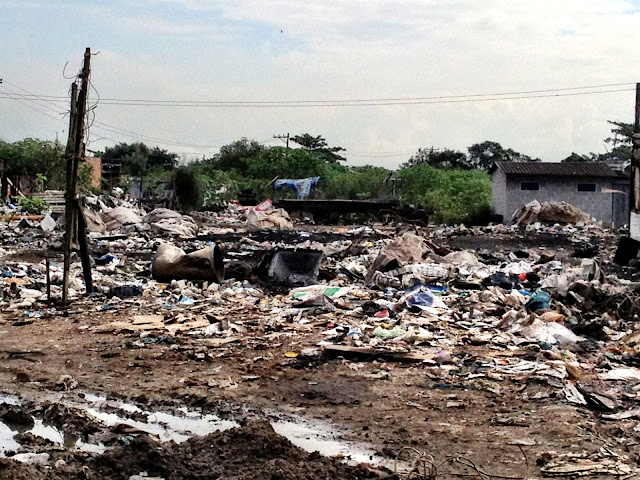
Toxic pool of water outside Jardim Gramacho, Rio's largest dump.

Made world-famous by the artwork of Vic Muniz and the film Waste Land, this massive urban dump was, until recently, the last resort for honest employment for many poor Brazilians. Lacking municipal recycling pickup or facilities, nearly all of Rio's garbage was dumped in astonishing quantities in Jardim Gramacho -- food waste, glass, plastic, metals, books, and every crazy random thing one can imagine. The trash picker's, called catadores were then forced to scramble over piles of trash, risking constant injury and putrid conditions to recover huge quantities of valuable materials carelessly discarded. This situation was toxic for the trash pickers and the environment alike. The water, land, and air around the dump received a cocktail of toxins and waste spilled out, or was burned, around the dump.


Communities outside Jardim Gramacho


As part of our work at the UN Conference on Sustainable Development (Rio+20), I joined a few members of the NRDC team for a visit to Jardim Gramacho and an inspirational meeting with the inspirational leader Ti?o dos Santos, president of the Association of Waste Pickers of Jardim Gramacho. There, we saw in living color how closely the health of humans and the environment are tied together. Poorly planned dumps like Jardim Gramacho are among the many sources of vast quantities of waste, especially plastics used for packaging, that end up as pollution on every coast, and in every ocean, river and lake on Earth. Waste also flows directly from city streets where it is improperly discarded -- out into the ocean through storm drains.

Fortunately, there are exciting efforts underway to change this whole system for the better, and Ti?o is among those leading the sea change. He and his colleagues were featured in the award-winning film Waste Land, and the funds from the sale of Muniz's artwork have allowed the pickers to formalize and negotiate for more rights. With the closing of Jardim Gramacho -- it was closed because of the tremendous environmental damage it causes from the leaching of toxins into the soil and sea water -- Ti?o has moved on to a wider campaign to educate the public about the impact of carelessly using and discarding trash.

?Eo Sou Catador? --? ?I Am a Trash Picker? features celebrities motivating the public to take action.


Public education is important, but it also must be paired with facilities that can accept recyclable materials; and ultimately, we need to put an end to the careless use and discarding of these materials.

NRDC is working at Rio+20, and beyond, to advance systemic solutions to the problem of plastic waste in the marine environment. To do this, we have created a Global Call and Commitment to Stop Plastic Pollution. This website showcases governments, businesses, and organizations that are helping to stop pollution at it's source.

We need manufacturers and producers that use vast quantities of cheap plastic to deliver goods to market to bear more responsibility for the impacts of their products, especially the plastic packaging it comes in. Cities have trouble paying for recycling, and in much of the world, there simply isn't recycling, or even basic trash pick-up. This systemic change is known as extended producer responsibility.

Here at the Rio+20 summit, and beyond, we are calling on governments, businesses, and organizations to commit to participating in extended producer responsibility and other waste reduction measures. With these steps, we can create a healthier environment for all.

This blog originally appeared in NRDC's Switchboard.

?

?

?

Follow Leila Monroe on Twitter: www.twitter.com/@saveoceans

"; var coords = [-5, -72]; // display fb-bubble FloatingPrompt.embed(this, html, undefined, 'top', {fp_intersects:1, timeout_remove:2000,ignore_arrow: true, width:236, add_xy:coords, class_name: 'clear-overlay'}); });

ludwig mies van der rohe jamie lynn sigler mega millions jackpot black panther party frank martin pink slime eagle cam

Introducing: Taylor Kubota

This is a series of Q&As with young and up-and-coming science, health and environmental writers and reporters. They ? at least some of them ? have recently hatched in the Incubators (science writing programs at schools of journalism), have even more recently fledged (graduated), and are now making their mark as wonderful new voices explaining science to the public.

Today we introduce you to Taylor Kubota (blog, Twitter).

Hello, welcome to The SA Incubator. Let?s start from the beginning: where are you originally from?

Hi, and thanks for showing interest in me. I grew up in gorgeous Santa Rosa, California ? about 60 miles north of San Francisco. I went to UC San Diego in La Jolla, California for four years and then I came straight to Manhattan for graduate school.

How did you get into science and how did you get into writing? And how did these two trajectories fuse into becoming a science writer?

I took courses from 11 different science and social science departments in undergraduate because I craved the variety. Unfortunately, my dalliances with so many different subjects made it hard for me to figure out what to do after graduation. A professor that I turned to for advice asked me what my dream job would be and I said, ?I?d want to be a student forever.? And that?s what science journalism is for me. I get to learn something new every day with the extra perk of sharing my lessons with others.

As for writing, I?ve always been a writer, from short stories when I was 6 to a hefty thesis my senior year at UC San Diego. I was completely shocked when I learned there was a career out there that could mix my love of science with my passion for writing. I still kind of am.

How do you find suitable stories to write about? What are your criteria?

My biggest concern when I am looking for a story idea is that I might write a story that?s been done to death. As a result, I tend to choose topics that are off the beaten path. (Think: the health repercussions of kids not showering after gym class or a profile of a professor who makes educational video games.) These ideas generally come from random curiosity or encounters with really fascinating (but not necessarily news-y) trends or people. My preference for strange subjects usually results in at least one day in my writing process where I?m convinced that I was out of my mind when I chose whatever topic I did. Still, in the end, I?m proud of the individuality ? perhaps quirkiness ? I bring to the table and I?ve been very happy with my results.

Why did you decide to attend a specialized science/health/environmental writing program instead of a generalized journalism or writing program, or just starting a blog and hoping to break into the science writing business?

It was a very straight-forward decision for me. Since I hadn?t ever done journalism of any kind and didn?t have a writing degree, I knew that going to a master?s program that specialized in science writing would be the best way for me to gain the knowledge and experience I needed to become a quality science journalist.

How do you see the current and future science media ecosystem, how it differs from the past, and what role will new, young science communicators like yourself play in building it and making it the best it can be?

Yes, Superman was a journalist

Yes, Superman was a journalist

The science media ecosystem these days is in constant flux, so it?s difficult to describe. There is definitely more of a need than ever to reach out to our audiences and to actually interact with them. Also, because many of our lives are now open books on the internet, there is more of a demand to let our readers/watchers/listeners know that there is a human being at the other end of our words and to be the same person off the page that you are on it. I?m actually quite excited for that change. It inspires me to always put a little bit of myself into my writing.

From what I?ve seen, young science communicators are seriously pushing themselves to gain experience in all different kinds of media and to be innovative with what they?ve learned. This is resulting in spectacular new ways to communicate science to the masses. (For example, this hydro-fracturing explainer that some NYU students made last year with ProPublica still blows my mind.)

Apart from writing, do you also do other aspects of science communication, e.g., podcasts, video, art/illustration, photography, infographics, or do you do any coding, web design and programming?

I have made a few videos, I was one of the science correspondents for NYU?s news program, and I love taking photos for my stories. This one is my new favorite. I have also started to learn some coding, some animation, and I made my own website (with much assistance from a website creation program). At the moment, I am attempting to make an infographic but that is the most extreme case of a work in progress that you can imagine. I generally stay away from art/illustration because I respect it too much to contribute my sad stick figures.

Which article of yours is your favorite and why?

It?s really difficult to choose but I would say my favorite so far is the story I wrote about whether parent?s plastic surgery could psychologically affect their children. It was a really outrageous idea to pitch because it was just a question that popped into my mind for no particular reason. It also wasn?t a story with a clear-cut answer. Those can be the hardest to write but a lot of times I find that they are the closest to the truth. In the end, the response that I got from both my sources and readers was that my story was thought-provoking while still being true to the science and that was ? and still is ? extremely rewarding.

What are your plans for the future?

I am planning to create science stories for a general audience. Not just a general science audience but as general an audience as possible. I want what I make to be the kind of story that someone would want to read or watch on a plane, not something they feel compelled to take in so that they can sound smart. (But hopefully my stories can actually make them smarter too.) I?m not sure what kind of media I?ll go into yet. So far, I really enjoy blogging, reported essays and video but I?m keeping my options open.

Thank you!

Thank you!

====================

Previously in this series:

Kristina Ashley Bjoran
Emily Eggleston
Erin Podolak
Rachel Nuwer
Hannah Krakauer
Rose Eveleth
Nadia Drake
Kelly Izlar
Jack Scanlan
Francie Diep
Maggie Pingolt
Jessica Gross
Abby McBride
Natalie Wolchover
Jordan Gaines
Audrey Quinn
Douglas Main
Smitha Mundasad
Mary Beth Griggs
Shara Yurkiewicz
Casey Rentz
Akshat Rathi
Kathleen Raven
Penny Sarchet
Amy Shira Teitel
Victoria Charlton
Noby Leong and Tristan O?Brien

?

luke kuechly brad miller chandler jones peyton hillis carolina panthers fletcher cox charlotte bobcats

Monday, June 18, 2012

Earnhardt Jr.'s win caps career revival

Dale Earnhardt Jr. celebrates in victory lane after winning the NASCAR Sprint Cup Series Quicken Loans 400 auto race at Michigan International Speedway, Sunday, June 17, 2012, in Brooklyn, Mich. (AP Photo/Carlos Osorio)

Dale Earnhardt Jr. celebrates in victory lane after winning the NASCAR Sprint Cup Series Quicken Loans 400 auto race at Michigan International Speedway, Sunday, June 17, 2012, in Brooklyn, Mich. (AP Photo/Carlos Osorio)

Dale Earnhardt Jr.'s crew members celebrate their win in the NASCAR Sprint Cup Series Quicken Loans 400 auto race at Michigan International Speedway, Sunday, June 17, 2012, in Brooklyn, Mich. (AP Photo/Carlos Osorio)

Dale Earnhardt Jr., left, is congratulated by Jimmie Johnson after winning the NASCAR Sprint Cup Series Quicken Loans 400 auto race at Michigan International Speedway, Sunday, June 17, 2012, in Brooklyn, Mich. (AP Photo/Bob Brodbeck)

(AP) ? Dale Earnhardt Jr. had finally reached Victory Lane again, ending one of the longest stretches between wins in Sprint Cup history.

He had gone 143 races without finishing first ? but not all of those defeats ended in failure. Over the last couple years, Earnhardt has methodically worked his way back among NASCAR's elite, to the point where his victory at Michigan International Speedway seemed almost inevitable.

It really was only a matter of time.

"I feel like we are getting stronger," Earnhardt said. "This year, we have gotten faster throughout the year. We started off pretty quick and we have gotten quicker, and quicker, especially these last couple weeks. So that's been a thrill for me."

Earnhardt's first Cup victory since 2008 came in convincing fashion when he beat Tony Stewart by 5.393 seconds Sunday. When the black Chevrolet with the green No. 88 crossed the finish line, Earnhardt could stop answering questions about when he was going to win again. Now, he's a legitimate contender for the overall series championship.

Earnhardt is second in the points standings and has been consistently impressive all year.

"We have a conference meeting on Tuesday with all of the drivers and crew chiefs and that will be a thrill since we won," Earnhardt said. "But we have got to start talking about the next race. We need to keep our eye on the goal and, like I said, we'll enjoy this, but we are ready for the next opportunity to win one, because this is fun."

It was Earnhardt's 19th Cup victory and his second in 159 starts for Hendrick Motorsports. He had 17 victories in 291 races for Dale Earnhardt Inc.

In 2009, he averaged a 23rd-place finish, but by last year, that average was up to 14.5. Sunday was his 12th top-10 finish in 15 starts this season. He's second to Matt Kenseth in the standings.

The victory came almost exactly four years to the day after his previous win in a Cup race. That also was in Michigan on June 15, 2008. He led for 36 laps a week ago at Pocono but made a late stop for gas instead of trying to stretch the fuel to the end.

On Sunday, it wasn't even close ? but Earnhardt was still sweating out the finish, waiting for the other shoe to drop during the final moments of the 200-lap race.

"I was in there just going crazy," he said. "I just knew I was going to come around the next corner and see a piece of metal laying in the racetrack. I just was waiting on something to happen. That was terrifying."

Earnhardt's 143 races between wins was the sixth-longest streak in Sprint Cup history.

"Dale had the fastest car all day," Stewart said. "It's not a national holiday, guys. This morning they were celebrating his fourth anniversary of his last win, so I guess we're all in a state of mourning now, because he's broke that string now, so I don't know what we're all supposed to think."

Like his last victory in Michigan, this one came on Father's Day ? fitting for the driver whose father is so revered around NASCAR circles. Dale Earnhardt Sr. died in a last-lap crash at the Daytona 500 in 2001. "Junior" is now stock-car racing's most popular driver.

"They stayed loyal," he said. "As soon as I got out of the car, that was my initial thought ? was about how many people were in their living rooms screaming at the top of their lungs, or running out in the yard, or whatever they do. I just wish I could see it all at once."

Earnhardt moved past pole winner Marcos Ambrose on lap 70 to take the lead, and although Stewart would lead for a bit, Earnhardt was in front again not long after the race's halfway point.

Earnhardt led on lap 171, after a pitting cycle. With 25 laps remaining, he was ahead by 1.978 seconds. With 10 remaining, he had built a 5.468-second cushion.

The end was almost anticlimactic, and it gave the team a measure of vindication after Earnhardt played it safe at Pocono.

"It just proves to us that our strategy is correct," crew chief Steve Letarte said. "If you bring fast enough racecars, you don't have to get outside your comfort zone too far."

After finally winning, Earnhardt stopped in front of the grandstand and spun his wheels in front of thousands of fans who were on their feet screaming.

Kenseth finished third in the 400-mile race, which included eight cautions for 39 laps and a rain delay of a couple hours at the beginning. After practice and qualifying speeds soared over 200 mph on the newly paved surface at MIS, teams switched left-side tires for the actual race.

Earnhardt seemed agitated after a special practice session Saturday night following the tire switch.

"I was desperate in that last practice to get something to work," he said. "When it ended, I still wasn't really sure if we were where we needed to be. I woke up this morning, just antsy, not knowing how this was going to play out."

It worked out just fine for Earnhardt.

"This is incredible," Earnhardt said. "I just didn't know when it would happen. I knew it was going to happen, just didn't know when."

Associated Press

karl rove miramonte elementary school mark jenkins super bowl commercials 2012 mia amar e stoudemire m.i.a.

Video: Walker: Obama's economic plan "not the answer" (cbsnews)

Share With Friends: Share on FacebookTweet ThisPost to Google-BuzzSend on GmailPost to Linked-InSubscribe to This Feed | Rss To Twitter | Politics - Top Stories Stories, RSS Feeds and Widgets via Feedzilla.

nfl games jesus montero hiroki kuroda kuroda nfl scores nfl scores gene hackman

Rural vote crucial in battle over gay marriage (Star Tribune)

Share With Friends: Share on FacebookTweet ThisPost to Google-BuzzSend on GmailPost to Linked-InSubscribe to This Feed | Rss To Twitter | Politics - Top Stories Stories, RSS Feeds and Widgets via Feedzilla.

tony blankley steelers charles barkley beyonce troy polamalu james harrison james harrison